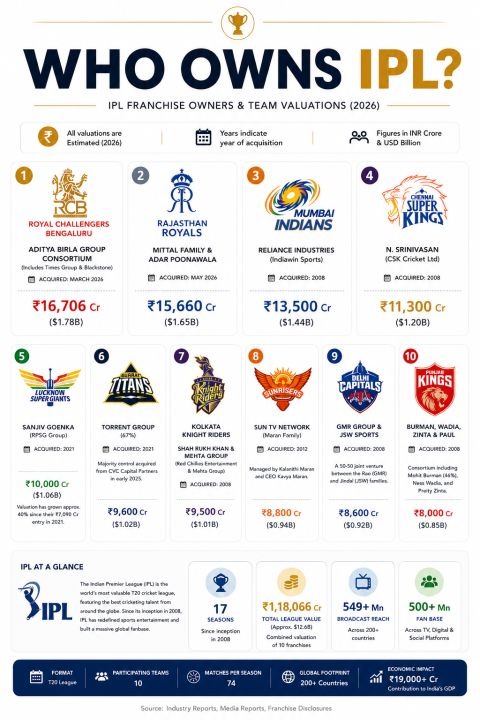
The Indian Premier League has transcended the boundaries of cricket to become one of the most valuable sporting properties on the planet. With a combined franchise valuation of ₹1,18,066 crore (approximately $12.6 billion) in 2026, the IPL is no longer just a T20 cricket tournament — it is a billion-dollar sporting empire that generates economic impact rivalling some of the world’s most established sports leagues. The league’s extraordinary rise from a bold experiment in 2008 to a multi-billion dollar ecosystem in just 17 seasons is a story of visionary ownership, strategic media partnerships, and the sheer commercial power of cricket in a nation of 1.4 billion people.
IPL Franchise Valuations 2026: A Billion-Dollar Club Where Every Team Is a Winner
The 2026 valuations paint a remarkable picture. Royal Challengers Bengaluru, recently acquired by a consortium led by the Aditya Birla Group along with the Times of India Group, Bolt Ventures (owned by David Blitzer), and Blackstone, now sits at the top of the table with a staggering valuation of ₹16,706 crore ($1.78 billion). The acquisition, completed in March 2026 from Diageo subsidiary United Spirits, was a watershed moment that signalled the arrival of institutional and global private equity capital into Indian cricket. Under the new ownership, Aryaman Vikram Birla serves as Chairman, bringing fresh energy and a modern vision to one of the IPL’s most beloved franchises.
Close behind is Rajasthan Royals at ₹15,660 crore ($1.65 billion), following a landmark ownership transition in May 2026 that brought in the Mittal Family and Adar Poonawala. Mumbai Indians, owned by Reliance Industries through their Indiawin Sports division, holds the third position at ₹13,500 crore ($1.44 billion), continuing to leverage the unmatched commercial might of the Ambani business empire. Chennai Super Kings, the franchise synonymous with N. Srinivasan and CSK Cricket Ltd, commands a valuation of ₹11,300 crore ($1.20 billion), a testament to the enduring power of brand loyalty in Tamil Nadu and beyond.
What makes the current landscape truly extraordinary is that every single IPL franchise is now valued at or near the billion-dollar mark. The Lucknow Super Giants, owned by Sanjiv Goenka‘s RPSG Group, stand at ₹10,000 crore ($1.06 billion) — representing a 45% appreciation from their ₹7,090 crore entry price in 2021. Gujarat Titans, with the Torrent Group holding 67% majority control following the acquisition from CVC Capital Partners in early 2025, are valued at ₹9,600 crore ($1.02 billion). Kolkata Knight Riders, the franchise that brought Bollywood glamour to cricket through Shah Rukh Khan‘s Red Chillies Entertainment and the Mehta Group, sits at ₹9,500 crore ($1.01 billion).
Sunrisers Hyderabad under the Sun TV Network‘s Maran family, managed by Kalanithi Maran and the dynamic Kavya Maran, are valued at ₹8,800 crore ($0.94 billion). Delhi Capitals, a 50-50 joint venture between the GMR Group and JSW Sports representing the Rao and Jindal families respectively, stand at ₹8,600 crore ($0.92 billion). And Punjab Kings — the colourful consortium of Mohit Burman (Dabur), Ness Wadia, and Preity Zinta — round out the top ten at ₹8,000 crore ($0.85 billion).
The Economics of Scale: How the IPL Built a $12.6 Billion Ecosystem
The financial architecture of the IPL is as impressive as any Silicon Valley tech company. At its foundation lies the massive media rights deal for the 2023-2027 cycle, valued at ₹48,390 crore (approximately $6.4 billion). This historic agreement split broadcasting rights between Disney Star for television (₹23,575 crore) and Viacom18‘s JioCinema for digital streaming (₹23,758 crore), creating a dual-platform distribution model that reaches over 549 million viewers across 200+ countries. The per-match value of IPL broadcasting rights now places it among the most expensive sports content in the world, comparable to the English Premier League on a per-match basis.
But media rights are just one pillar of the IPL’s economic engine. The league generates an estimated ₹19,000+ crore in annual economic impact to India’s GDP through a complex web of direct and indirect contributions. Title sponsorships, team sponsorships, stadium advertising, player endorsements, hospitality, merchandise, fantasy gaming partnerships, and the burgeoning ecosystem of digital fan engagement all contribute to this extraordinary economic footprint. The 74 matches played across each season create a concentrated, high-intensity window of commercial activity that advertisers and brands treat as India’s unofficial marketing season.
Beyond the Boundary: How IPL Franchises Are Building Global Sports Empires
Perhaps the most forward-looking aspect of the IPL story is how franchise owners have taken the model global. The IPL is no longer confined to the Indian subcontinent. Team owners are investing in T20 leagues across South Africa, the UAE, the United States, and the Caribbean, creating multi-club ownership ecosystems that mirror the structures seen in European football. Mumbai Indians, Kolkata Knight Riders, and Rajasthan Royals have been among the most aggressive in acquiring stakes in overseas cricket franchises, essentially building global cricket conglomerates with the IPL franchise at their core.
This expansion strategy transforms IPL franchises from seasonal entertainment properties into year-round global sports brands. The implications are enormous. Cross-pollination of talent scouting, shared data analytics, co-branded merchandise, multi-league fan memberships, and integrated content strategies across markets mean that IPL team owners are effectively building the cricketing equivalent of the City Football Group or Red Bull’s multi-club football empire. These structures create compounding value — as the global T20 ecosystem grows, the IPL brand at the centre appreciates even further.
The Technology and Data Revolution Driving Future Growth
The next decade of IPL growth will not be driven solely by traditional revenue streams. The convergence of technology, data analytics, and artificial intelligence is opening entirely new frontiers for fan engagement and monetisation. AI-driven personalised fan experiences — from customised viewing feeds to real-time predictive analytics during matches — are already being piloted. Fantasy gaming platforms, which have seen explosive growth in parallel with the IPL, are generating billions of rupees in annual revenue and creating a secondary economy around cricket that barely existed a decade ago.
The concept of digital fan communities and global fan memberships is gaining momentum. In a country where the fan base for the IPL exceeds 500 million across television, digital, and social media platforms, even modest per-fan monetisation through subscription models, exclusive content, virtual experiences, and creator-led content could generate transformative revenues. Sports tourism is another untapped opportunity — the prospect of dedicated IPL fan travel packages, immersive stadium experiences, and city-wide festival economies during match days is only beginning to be explored.
The New Breed of Owners: From Industrialists to Global Investors
The evolution of IPL ownership tells its own powerful narrative. In the early days, franchises were predominantly acquired by Indian industrialists and Bollywood celebrities — a mix of passion, prestige, and nascent commercial opportunity. Today, the ownership landscape has matured dramatically. The entry of global private equity giants like Blackstone, institutional investors like Bolt Ventures’ David Blitzer (who also holds stakes in multiple global sports franchises), and the participation of billionaire families like Rob Walton of Walmart fame in the Rajasthan Royals consortium reflects a fundamental shift. IPL franchises are now being valued and traded like premium global assets, attracting the same class of sophisticated investors who buy European football clubs and American sports teams.
This professionalisation of ownership brings with it a new level of governance, strategic planning, and long-term investment thinking. The BCCI‘s role as the league’s governing body remains central, but the increasing sophistication of franchise operations — from dedicated analytics departments and youth academy pipelines to content studios and international business development teams — means that each franchise is now a standalone business operation with diverse revenue streams and growing enterprise value.
India’s Sports Economy: The IPL Is Just the Beginning
India’s sports economy remains in its relative infancy compared to mature markets like the United States, where the combined value of the four major professional leagues exceeds $200 billion. The fact that the IPL alone has reached $12.6 billion in combined franchise value within 17 seasons suggests that the potential for the broader Indian sports ecosystem is staggering. If India can replicate even a fraction of the IPL’s success in football (through the Indian Super League), kabaddi (through the Pro Kabaddi League), badminton, tennis, or emerging sports, the total addressable sports economy could grow exponentially in the next decade.
Industry experts and franchise owners are already projecting that individual IPL team valuations could reach $4 to $5 billion within the next ten years, which would place them on par with mid-tier English Premier League clubs and lower-tier American NFL or NBA franchises. With India’s digital infrastructure continuing to expand rapidly, disposable incomes rising across smaller cities, and the cultural primacy of cricket in national life showing no signs of diminishing, the trajectory for the IPL’s economic growth remains extraordinarily positive.
The Real Story: Where Culture, Commerce, and Capital Converge
The Indian Premier League in 2026 stands at a remarkable inflection point. It has proven that Indian sports can generate globally competitive valuations. It has demonstrated that cricket can be packaged, marketed, and monetised with the sophistication of any Fortune 500 brand. And it has shown that the intersection of entertainment, technology, media, and passionate fandom can create an economic ecosystem that benefits everyone — from the smallest street vendor outside a stadium to the most powerful boardrooms in Mumbai, Chennai, and Bengaluru.
As the franchise valuations in 2026 confirm, the IPL is not merely a sports league. It is a cultural institution, an economic engine, and a blueprint for the future of sports business in the world’s most populous nation. The billion-dollar bids, the global ownership consortiums, the AI-driven fan experiences, and the cross-border franchise empires are all chapters in a story that is still being written. And if the first 17 seasons are any indication, the most exciting chapters of the IPL’s extraordinary journey are yet to come.
Leave a Reply